
Journal · Raspberry PI
The New Raspberry Pi 5

Discover unparalleled computing prowess with the Raspberry Pi 5 - 8GB model, the newest iteration in the groundbreaking Raspberry Pi single-board computer series. Engineered by the Raspberry Pi Foundation, this innovative device sets new…
Discover unparalleled computing prowess with the Raspberry Pi 5 - 8GB model, the newest iteration in the groundbreaking Raspberry Pi single-board computer series. Engineered by the Raspberry Pi Foundation, this innovative device sets new standards for performance and versatility in the single-board computer arena.
With its 2.4GHz quad-core ARM Cortex-A76 CPU, the 8GB Raspberry Pi 5 model offers an astonishing leap in processing power, making it up to 3x faster than its predecessors. It’s an excellent choice for a wide range of Raspberry Pi projects including IoT, home automation, and Raspberry Pi Python programming.
The device is also the first to incorporate custom-designed silicon with its RP1 "Southbridge" I/O controller, significantly boosting peripheral performance. USB 3.0 ports provide a more than 2x increase in total USB bandwidth, and the all-new single-lane PCI Express 2.0 interface allows for the connection of higher-bandwidth peripherals.
We offer a plethora of Raspberry Pi tutorials and a comprehensive Raspberry Pi workshop for beginners to get you started on your Raspberry Pi journey.
Key Raspberry Pi Features:
2.4GHz quad-core ARM Cortex-A76
Next-gen VideoCore V3D VII Graphics—2-2.5x faster than Raspberry Pi 4
Hardware 4Kp@60Hz HEVC decoding
4 LPDDR4x RAM options for scalability: 1GB, 2GB, 4GB, and 8GB (this listing)
USB-PD support for enhanced power management
Onboard Power Button and Real-Time Clock with RTC Battery connector (Not Included)
Custom RP1 'Southbridge' I/O Controller
Single-lane PCIe Gen 2 for Raspberry Pi expansions
High-speed MicroSD slot with SRD104 mode
2 x 4-lane MIPI connectors for Raspberry Pi cameras and displays
Dedicated Raspberry Pi Fan Connector
2 × USB 3.0 and 2 × USB 2.0 ports
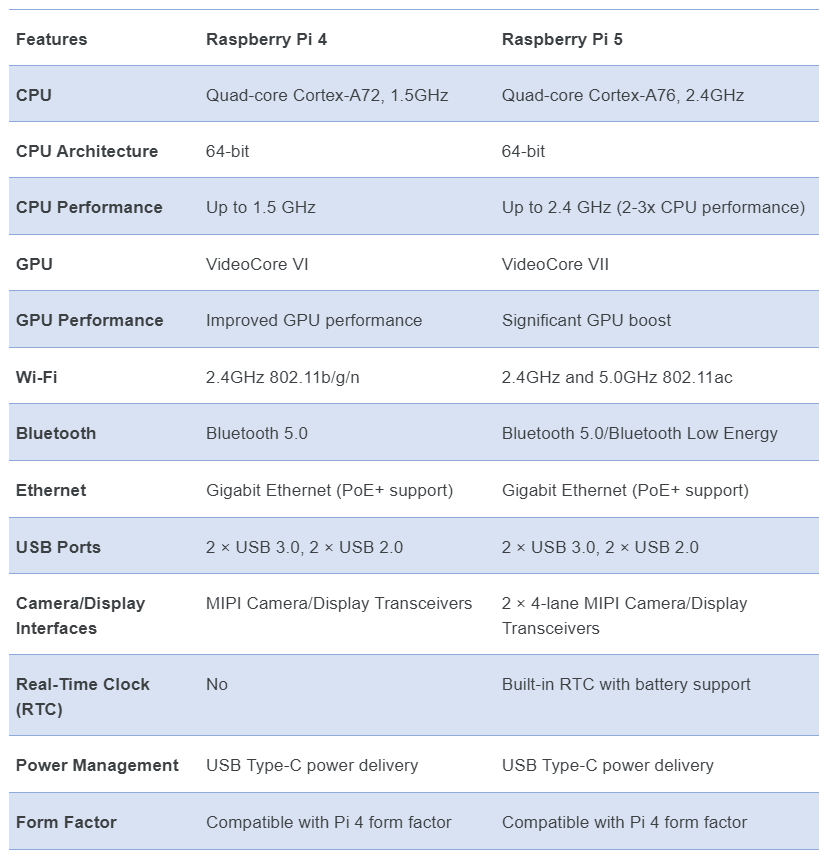
A Comparison to Its Predecessor:
.jpg)
The Raspberry Pi 5 has set a remarkable benchmark in the world of single-board computing. The new version has a significantly better CPU performance, 2-3 times better than the previous version.
Additionally, the GPU capabilities have also been improved. This new version is not just a small upgrade, it offers much more.
Let's delve into what makes the Raspberry Pi 5 a standout choice for tech enthusiasts, developers, and hobbyists alike.
Raspberry PI 5 Board Layout:
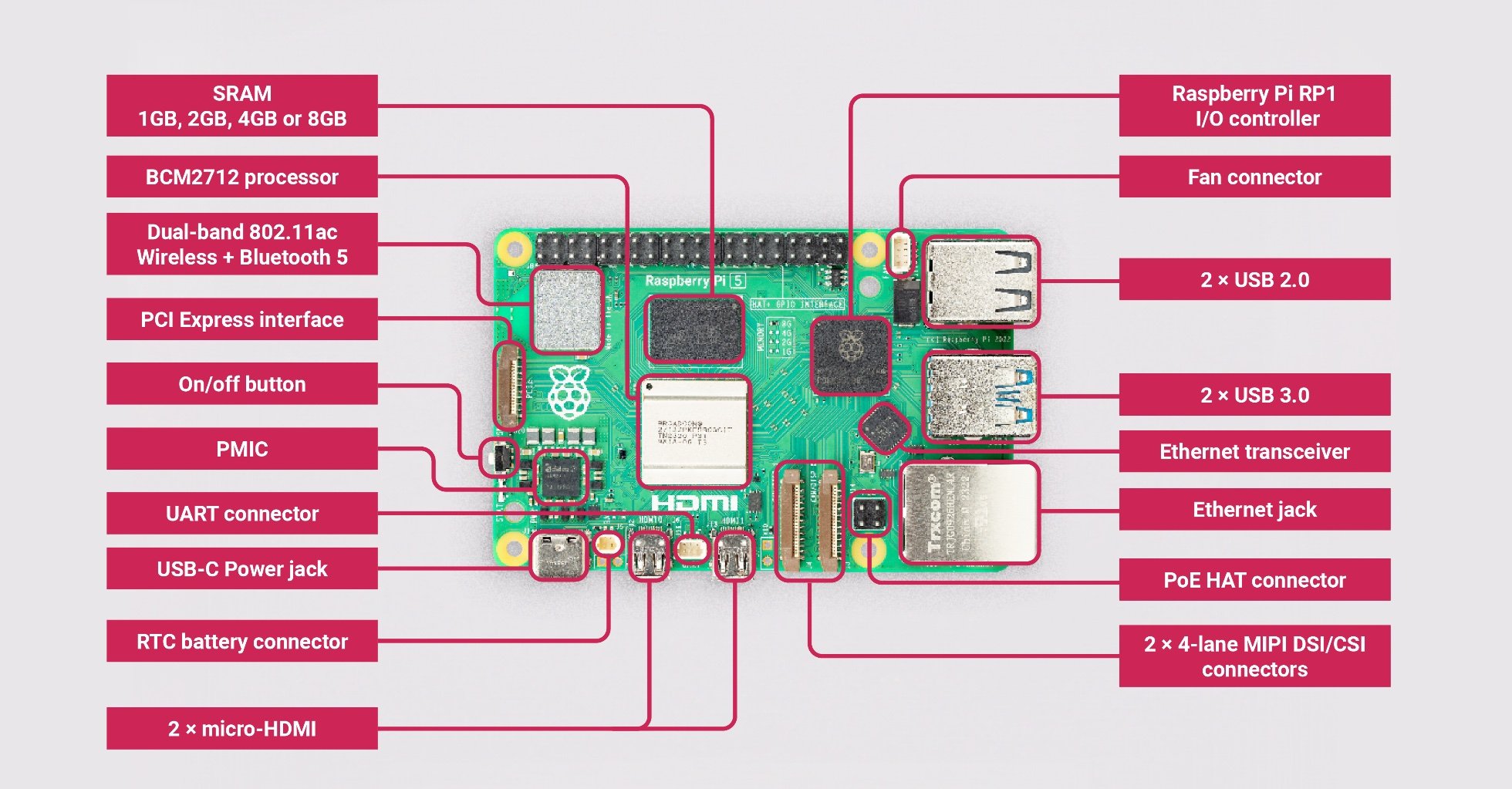
CPU: It consists of a Broadcom BCM2712 chip which contains a 2.4GHz 64-bit quad-core ARM Cortex-A76 processor(Architecture-ARMv8.2-A).
GPU: Broadcom VideoCore VII (800 MHz) was released in 2023. It is capable of quality video playback, HEVC 4K@60fps,max display resolution2x 3840 x 2160@60Hz; OpenGL ES, 3.1 graphics and vulkan 1.2.
RAM: It comes with 4GB, and 8GB of LPDDR4X-4267 SDRAM.
USB port: It consists of two USB 3.0 ( for Full 5GB p/s bandwidth ) and two USB 2.0 ports to connect it to an external keyboard, mouse, or other peripheral devices.
USB power port: It consists of a 5V/5A DC power via USB-C, with Power Delivery support
HDMI port: Two micro HDMI ports capable of supporting up to 4k@60HZ resolution.
Ethernet Jack: It comes with Gigabit Ethernet, with PoE+ support (requires separate PoE+ HAT)
SD card Slot: features a microSD card slot that offers double SD card performance with high-speed SDR104 mode.
PCI Express interface:allows you to connect an M.2 SSD to your Raspberry Pi, giving you speedy data transfer and super-fast boot.
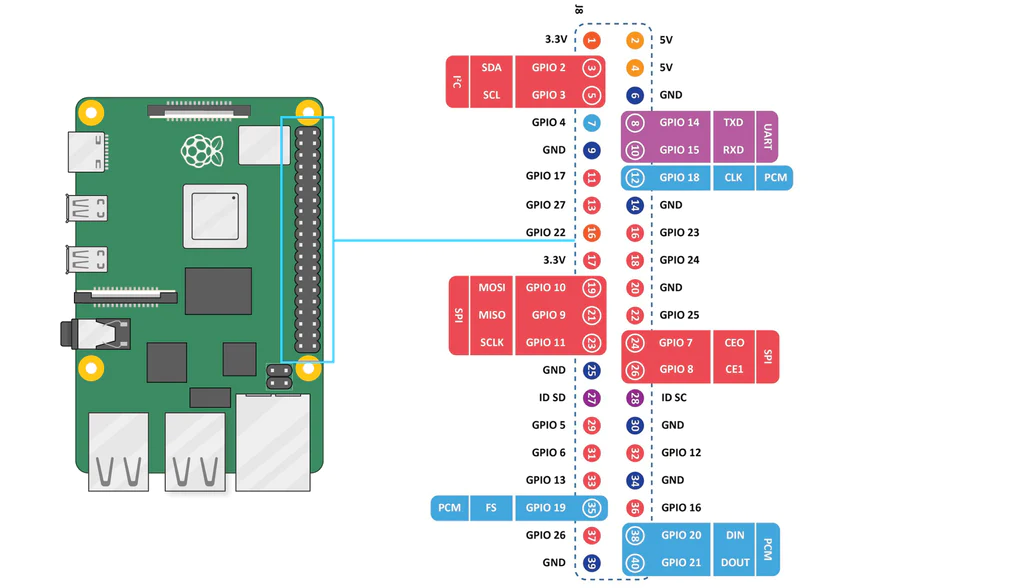
RPI 5 GPIO Pinout:
the pinouts to the Raspberry pi 5 are exactly the same as in the Raspberry Pi 4 40-Pin header.
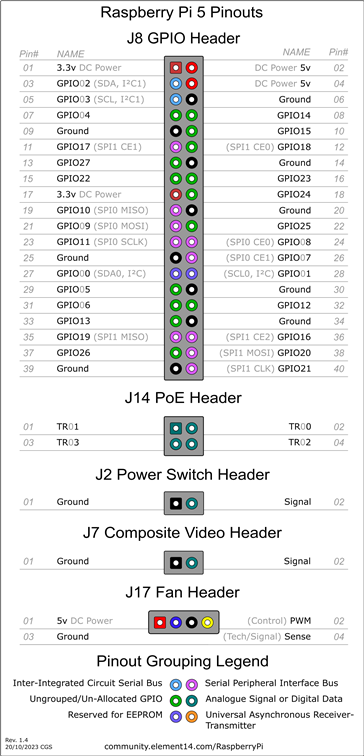
In this diagram, we cover the following headers:
- J8 GPIO Header: This is the default 40-pin GPIO header.
- J14 PoE: Power over Ethernet (PoE) connection.
- J2 Power Switch: While not officially confirmed, it may be related to the Real-Time Clock (RTC) battery.
- J7 Composite Video: Composite video output (no longer on an audio jack).
- J17 Fan Header: This header allows for PWM control and provides feedback for the fan's speed.
The RP1 GPIO bank (IO_BANK0) supports the following functions:
- 5 UART interfaces
- 6 SPI interfaces
- 4 I2C interfaces
- 2 I2S interfaces (including Clock Producer and Clock Consumer instances)
- Registered IO (RIO) interface
- 24-bit DPI output
- 4-channel PWM output
- Stereo PWM audio output (AUDIO_OUT)
- General-purpose clock input and output (GPCLK)
- eMMC/SDIO bus with a 4-bit interface
- Interrupt generation from pin level or edge transitions
Raspberry Pi 5GPIO Pin Description:
This model consists of a 40-pin GPIO header. Out of these 40 pins, 28 pins are GPIO pins.
Power pins:
The power pins on a Raspberry Pi are used to provide electrical power to the device. The Raspberry Pi typically uses a micro USB or USB-C connector for power, depending on the model.
5V: The 5v pin outputs the 5 volts coming from the USB Type-C port,(Pin number 02,04).
3.3V: The 3v pin is used to provide a stable 3.3v supply to external components,(Pin number 01).
GND: The ground pin is commonly referred to as GND,(Pin numbers 6,9,14,20,25,30,34,39 ).
Outputs:
When set as output, these pins can be used to send electrical signals to external devices such as LEDs, motors, relays, and more
A GPIO pin designated as an output pin can be set to high (3.3V) or low (0V).
Inputs:
pins on a Raspberry Pi can be configured as inputs to read signals from external devices such as buttons, switches, sensors, and more.
A GPIO pin designated as an input pin can be read as high (3.3V) or low (0V). This is made easier with the use of internal pull-up or pull-down resistors. Pins GPIO2 and GPIO3 have fixed pull-up resistors, but for other pins this can be configured in software.
PWM(pulse -width modulation):
Pulse Width Modulation is a method used to control the analog output using a digital signal. On the Raspberry Pi, PWM can be used to control the brightness of LEDs, the speed of motors, and other similar applications.
-
Software PWM available on all pins
-
Hardware PWM available on GPIO12, GPIO13, GPIO18, GPIO19
SPI(Serial Peripheral Interface):used to communicate with SPI devices. SPI is a synchronous serial communication protocol commonly used to interface with sensors, displays, and other peripherals.
-
SPI0: MOSI (GPIO10); MISO (GPIO9); SCLK (GPIO11); CE0 (GPIO8), CE1 (GPIO7)
-
SPI1: MOSI (GPIO20); MISO (GPIO19); SCLK (GPIO21); CE0 (GPIO18); CE1 (GPIO17); CE2 (GPIO16)
I2C(Inter-Integrated Circuit):
is another serial communication protocol commonly used to connect multiple devices on a bus. It's a multi-master, multi-slave protocol, allowing multiple devices to communicate with each other using a two-wire interface. The two wires are SDA (Serial Data Line) and SCL (Serial Clock Line).
SDA: (GPIO2); SCL (GPIO3)
EEPROM Data: (GPIO0); EEPROM Clock (GPIO1)
Serial UART:(Universal Asynchronous Receiver-Transmitter):
is a common serial communication protocol used for point-to-point communication between devices. UART is asynchronous, meaning that it doesn't require a shared clock signal between the sender and receiver. Instead, both devices must agree on a specific baud rate, which represents the speed of data transmission.
-
TX Transimiter Pin (GPIO14); RX Receiver Pin (GPIO15)
Recommandation:
To ensure optimal Raspberry Pi 5 performance, we recommend adding a cooling solution, such as the official Raspberry Pi active cooler or Raspberry Pi case.
The Raspberry Pi 5 requires an official 5V/5A DC USB-C Raspberry Pi power supply. The use of third-party power supplies may compromise performance.
Blog.commentsTitle
Blog.commentsEmpty

